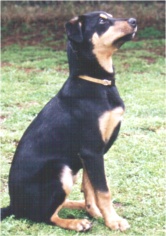
This was a very difficult order to fill and when we had a dog for him, he wasn't completely ready to import so we had to wait until another litter. We finally found a wonderful tough little girl in a litter by Noonbarra Dusty from Noonbarra Wendy.
Owned by Patrick Stubbe - Belgium
Noonbarra Keppe is the first Working
Kelpie exported to Belgium. Patrick Stubbe has owned a Border Collie
called Torka for three and a half years but has not had much
experience in training dogs and of course none at all in handling
Kelpies. He had been trying for some years to purchase a Kelpie and
had contacted a number of breeders including a well established USA
breeder. He named his Kelpie 'Keppe' which means 'Darling' in
Flemish.
Patrick works very unusual sheep.
In his own words: "Hebridean sheep derive directly from the sheep
left by the Vikings in northern Scotland. So they are closely related to the old
Norwegian and the Icelandic, the Shetland, the Faroer, the Orkney sheep... They
differ by selection and adaptation to the different possibilities they have
lived on in the last 1200 years."
November 9th 1998.
"Hope to start training within 12 months of age. I am rather searching for a dog that matures slow, but turns into a good worker, good thinker and lacks any fear."
November 17th 1998
"... My (Ram) sire easily attacks any dog (even a European - Mainland Champion Border Collie!) when he feels embarrassed or in danger or he senses the dog dares about him. I have seen well trained and working Border Collies (Ranch dogs that know their job1) who could not move my sheep at all! He (the Ram) respects the single dog from whom he knows have teeth together with a kind of mutual respect about the flock..... has at least the power to move those last five semi-mouflons caught in bushes on top of that sandy hill. "
Feb 16th 1999
"... My Border is a good dog for the winter job but has problems to work longer than half an hour during hot summer days."
May 5th 1999
" I need a dog with both lots of power but also good self control."
Sept. 11th 1999
"... I have a very small flock of 10 Black Welshes (sheep) that live beside a moorland next to a river. The side of the riverbank is not fenced. The sheep were completely left to themselves in a rather big paddock, when I purchased them. They did not know a dog nor a handler. They were only driven to a barn twice a year for shearing and worm control! Quite the opposite of dog broke sheep!
In that very difficult moorland, these sheep created real corridors towards the riverside and hid in them when feeling insecure or when I entered the area. I did not go there more than once a week, sometimes less. My Collie has a hard time to try to get these sheep under control. If he has them for a short time, they find a new point to escape and make it impossible for him to get behind them."
"Last time I had to get the Ram out of the river twice because he preferred swimming than to be held properly by the dog.... in my dreams, I think about how an experienced skilful Kelpie would solve such a problem..."
Sept.19th 1999
... " Strong enough to handle difficult sheep".
Aug 9th 1999 ...
" About my difficult stock .. Big horns are used for defence matters against predators. A roaming dog that meets these sheep for the first time and that comes alone has very few chances to ever touch one individual from the flock. I twice saw how a little flock of 8 sheep formed themselves into one V-shaped unity and went up straight towards the dog. ... Working with such difficult breeds, I have trouble handling those sheep who live in flocks of 10-15 on small grounds. ... My dog is three and half years old and not that completely strong enough to come into their noses and let those noses feel his teeth. So I need a little help until the sheep know what a dog is able to do.
July 11th 1999
... "(A dog that) resists Rams with large horns that are always ready to butt, finds out how to handle them face to face with absolutely no fear (mine still fears the horns after he got butted a few times at minus one and a half years of age..."
We did a lot of training on Noonbarra Keppe before she went over to him and videoed her occasionally working in the yards and the paddock. We thought she had the potential to be an outstanding dog and exactly right for Mr. stubbe going on the criteria he had sent us. She also had basic obedience and general training here first, including lead work, sit on command, "Down' command, 'come' command, able to be washed and handled easily, socialising, exposure to traffic, noise and housetraining.
She worked on a mob of about 150 in a hilly paddock (about 70 acres) and was able to work these sheep very well for her young age. We kept an older dog on hand in case she got into any problems. Noonbarra Keppe was also worked on small groups of sheep of 3 - 12 and was also capable of holding these. Just before she left for Belgium we also tried her in yards with about 15 sheep. She did extremely well and would easily peel them off the yard rails and showed an amazing amount of courage.
Basic obedience: Keppe responds very well on her basic
commands, including a "stay there", mostly as far as I am rather
close (within 10meters). We do not train this that intensely, but
every day, when walking, when being out for a play, when on stock. So
f.ex; I disturb often some routines by asking to stop, to go down, to
stay ... I insist that every command will be executed properly. Every
moment we are on stock is the ultimate test and training for to see
how good we are as a partnership...
I happen to go too quick, by trying to command her from a
distance, when she is very active, concentrated on an object and not
on me, aso... I work on my training competences for that. I am very
critical to my own behavior and try to observe her intensively. A
mail from Mary I think, explained about interesting "stay
there"-training. I immediately started to work on that and did
movements around, behind and over her after she was asked to down and
stay. This worked greatly from the first time. I often redo this, for
enhancing this.
Mr. Stubbe is working hard in his training of Noonbarra Keppe. He has found her to be very different to his current Border Collie. At first he allowed her to completely have her own way and ran into a few basic house training problems. After we advised him to be firm and more consistent, things went more smoothly. We received the following information in January and February 2000. Noonbarra Keppe would only be have been 6 months of age when she was doing this work!
It took a number of years before his Border Collie was able to fully handle these sheep. It sometimes surprises us that Noonbarra Keppe's brothers and sisters are just starting to learn basic stockwork and gain confidence while Noonbarra Keppe is already doing some things we would not do until a dog is two years or more, such as work three ewes each with a lamb at foot and a very protective ram (with four horns) that often attacks dogs. In Australia we would only attempt this with a mature, experienced sheepdog. Really Noonbarra Keppe is a bit too young to be doing advanced work like this and runs the risk of being hurt by the stock which are sometimes very aggressive.
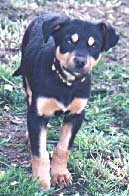
"I am aware about not to put to many pressure on her! Between any new trick, we do a lot of walkings, to comfort her with stock-working and the necessary praize for it! But one can see in her eyes she is proud to do the new things so good! (although she is absolutely not a dog that hangs on you and ask for approval, or confirmation...)
"Keppe responds very well on her basic
commands, including a "stay there.
STOCKTRAINING... This is really where she excels!
We now do short outruns: 5 to 10 meters from the spot where the sheep stand, I can lay her down and use a "away" or "comeby" command for getting her around the sheep. This is a thing I started just a few days ago. We seem to succeed 80% of the time. Of course I have to show her left and right with my bodylanguage and maybe with my crook to stop her when she took the wrong direction. But I can clearly see she reacts on those commands by widening her outrun slightly when coming behind the sheep.
I also train a down when she is behind the sheep. That is still hard to do. I train this when I work with some 6 sheep, so I can be rather quick straight before her and insist on her down... I see this works very well.
Another great thing she knows is the fact that even when she pushes the sheep to hard, she stays herself behind me 95% of the times instead of going to the heads directly. This happens when walking along the places and she is in covering modus. If the sheep pass me, I put a step in the other direction and Keppe stays behind and goes to the other end. I try to go almost as much as possible straight forwards on this. We realised this already for some weeks and now I have moments (with using my crook before the sheeps noses) I can walk some short distances with Keppe and the sheep staying behind me (lots of praise of course!).
Another thing was her working on really feral sheep. In the first two months I refused to work her on them. But as she learned to calm down even when she was bound on a tree to wait for Torka working those sheep, I decided to give her a chance. Torka had enhanced alot on these sheep and I had them say 80% under control..
I introduced Keppe on those sheep after I worked the 8 of them for some 15 min. withTorka and had a good succes. The sheep weren't that flighty anymore so Keppe had a fair chance to be quick enough. I could not believe my eyes! She worked them very effective and kept them close to me! Well it was clear she works different than my Torka does. He is a really strong eyed dog.
Torka can move the small flock from a distance of more than 25m and give them a smooth trot towards me. His problem is that the sheep start to run into the bush and beside the riverbank, so he cannot get behind them and has "lost". Well as Keppe works with her close presence, her intense wish and her coolness, she "pushes up" the flock and is always very close. This makes the sheep have no chance to run into a hidaway... I worked her twice on these sheep now and I must say she really impressed me! I had a big problem to get those sheep out of that place for next month. Now I know this wil not be a problem at all! Just give both dogs more chances to build up experience and let Torka do the complementary work to keep the small bunch together!
I have ewes that try to resist her. When so, (I come close and have my crook ready) I wait and give Keppe a fair chance to solve that problem. She almost just stops and gives no room. The ewes turn back and join their flock. All exept but one this week! An adult ewe started an attack, (vertical) horns forward straight to her... Here she gave room as much as necessary and returned immediately when the ewe had stopped.
No harm exept for Keppe not having had the chance to grip a nose or so (what she never has done until yet). But she happens to create a slightly bit more distance when covering the sheep.
I must say I almost never train her on the same (always small) flock. So if she has worked that ewe, she might not see her back after having met 4 other flocks...
And as I saw her working 30 yearlings + adult ewes in very wet land and crossing brooklets and bad (treeshelves) bridges easily, it is clear this little girl has lots of power.
With experience, Keppe happens to know more about the grounds where we work. So she happens to use a path within the heatherbush, aso, so she happens to widen her flanks. She also happens to do so in open grounds. I think she is starting to build up some balance... If so, I let you hear about that next month!
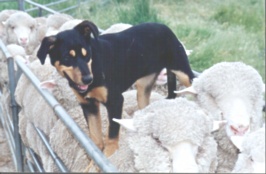
Feb. 2000
I just came in from a sundaymorning training session. We realised to make nice 20 m outruns this morning. After some 15min. just covering-walking, we started on this in a more consistent way. Firstly some 5m outruns (remembering her "away" and "comeby") and starting to work on a decent down when she arrives behind stock (4adult+3yearlings).
Then at my astonishment, she followed easily when I asked to "come" from stock and lay down for some 10m. and then wait until I were back close to stock and send her away (her best working side). We did this twice. Then again some walkings and over towards some bigger stuff! Well we did very consistent outruns on both sides (depending on the position of the sheep)... I even realised better and better downs when she arrived behind the flock. This went so good I even started a glimpse of a next exercice: to keep her down for a long distance behind stock and ask for a 5m walk and then down, walk again 5 m. and again down... Of course this will take some more time. But I've seen this won't take that long. When I have that, we can realise much more control over stock together...
A nice thing for the moment is the fact that both my dogs
show complementary skills. My Torka is a real eye dog who tries to
move with his position and eye only and from a 15m distance. As I
have some very very flighty sheep, this is a perfect working tool to
me. Although he shows in some other situations he comes in, uses bark
and grip as tools too, he always prefers to work on distance. So it
happens he creates problems when sheep dive into holes in the bush
where he cannot work them anymore. That's the moment when Keppes
power comes above! If I can introduce her to these sheep shortly
before they reach the bush, she comes in short behind the rear and
forces the little flock to come out and towards me! She is the one of
both that brings this difficult flock onto my knees. With Torka,
those sheep come onto 2m distance mostly... So I thought having a
problem with these 8 Black Welsh Mountain sheep for replacing them
into another ground. But now I feel secure that within some two
months the cooperation Keppe, Torka, + me will do the job rather
easily.
March 2000
Here at home, Keppe is the one that brings my 4 Ouessant sheep out of the barn every morning to bring them to a small yard. Ouessant are a dwarfbreed, but developed on an island without predators. So they lack a bit flockinstinct and are quite not easy to cover. Keppe is simply the best of both my dogs to work them! When for the first time she went in the barn (she slipped in without me asking to do...) the young ram would knock her, but she responded with a fair wool-bite. He resigned quickly. So Keppe can bring those sheep out of that barn easily
April 2000
Supported by your mail, I have reduced my training level a bit. We have worked on downs for a longer time. In fact to introduce a good down was not a problem at all. Within days we were on a reasonable level. Not the 100% Stephen spoke about.
Now, several weeks further, I have her on somewhat 95%, I could say 99% of the times I command a down when she is not in a running modus. The moments she has already decided to start a run, she is hard, better not yet ready to stop at all. What I have is not a "drop dead down " neither. When she walks behind sheep and I ask her to down she almost makes some 3 more steps. I do not agree, run to her to say I do not want that, aso... So we are still working on that.
When she has done a few runs, I can easily get her down and make her stay for a longer time. Even with working the sheep with the other dog and Keppe keeping in a "Down and Stay there". I cannot say this works 100% but yes she does very well on that.
But one can see how she, step by step, works on her balance, shows more and more eye, sometimes shows more stylish work... On other occasions, I let her work more without any comands, because of you dared about her trusting to quickly on my thinking and stopping to think for her own. But there I am aware even more to praise every good movement she makes!
On other places where I have no corral, she is allowed to handle the sheep while I am shearing. There she keeps the small flock close to me while I am shearing. That is great from her! On such moments she shows how decidedly she works and stays calm all the time... I think it is great excercise for holding together the flock... she is growing out to be a tall, agile dog, works lots and lots longer than the Border Collie does and seems not to be affected by the first heat we had... That were the basic reasons why I was interested in the breed. So Keppe will become a great help in my sheepwork...
She is not yet that far to really respond straightly to my flanking commands (making square flanks). But it is clear she responds to that. It is merely a kind of inner discussion between her direct goal (coming behind at 12 0'clock) and my command to go wider...
When she then brings the sheep, she stays perfectly behind,
waits until any sheep is going straight towards me. And I can
perfectly down her at lets say 15 m distance from me, so the sheep
stop right in front of me. I think that is nice work done for her age
(and my training abilities).
We have spent a good deal of time helping
Patrick to learn how to train a Kelpie.
..." thanks alot, for the kind interest for all both of you do to help me. This was great even before ever Keppe was shiped at all. OK we had a hard start, but that had to do with some misunderstandings and my lack of stockdog/kelpie knowledge. ... The fact that we stay in contact and both Stephen and you are trying to help me is a big support to me! I wished I could do something more than just thank you and try to become a good Kelpie-handler, inorder to reply to that support. - Patrick
April 2000
This is part of one of our letters to Patrick:
I think one of the most important lessons is to get a 100% 'Down-Stay' command. No compromises. No excuses. By now you should be able to do it all the time. If not, with persistence you should be able to teach her on a few quiet sheep with you only a few metres away, within a day or two.
As breeders we have learned a lot from our overseas customers, including yourself. We are now much more aware of our overseas customers having very little contact with the breed and we now endeavour to ask a lot more > questions about their work
You wrote that you are training her to go behind the sheep at the opposite side to you and then commanding 'down' but you haven't got it right yet. If I am understanding that correctly then why have you advanced to working at a distance? No trainer can build on shaky foundations. Each step of training should be solid. The dog should be 100% and tested before moving to something harder and more advanced.
Patrick's response:
"You have a point on that. I was really thinking about investing more on these basics!The fact is that downing when behind my sheep is not that usefull, (at first sight?). As my sheep are rather to very flighty all of them, one need a very alert dog that is always looking for the ones that try to escape or even the whole flock that runs further. I have not any sheep that come to me at ease and stay at my side!
What I was training her was more the act of making her covering work start from a longer distance. It is a fact she does it quite nicely. On the other hand, I can easily accept your criticism that I might push her up to much and forget about my basics. Well, once again, I think you are right. And it seems to be a bit of a problem to me not having any Kelpie handler around to learn from. I guess I'll need to stay in contact with you and hopefully some others and explain about my work, our advances we make. And surely to stay honest and try to describe what really happens. I think this last is the most difficult to do for an unexperienced handler.
As I read your mail last night, I decided to change my training scheme indeed. I will work more on this down when coming behind the sheep and becoming more strictly about her pushing up the sheep. Even with my sheep, she should learn to NEVER let them walk further than me, letting me to be the head of the walk. That is difficult with my sheep. And I know from earliers when starting Torka, I cannot find sheep that are easier, that accept me spontanuously as a guide, as a defence against predator... It is always a game of fine balance, good position (from either my side and the dog) and lots of training hours until those sheep act sweet. But then they become totally dogbroke. They know what will happen and even the sheep seem to know what is expected to do!" - Patrick
APRIL 2003
With Keppe, I think I now have a very relyable working partner. When replacing sheep, in and out the trailer, she is my absolute "working tool". The great thing is that other people (just like the responsables of the environmental projects) also mark how smoothly things work out.
With her now, I do different difficult chores in lesser that a 5th of the time I
used to spend some years ago! The great thing is that she became much more
reliable on long distance casts. This is the fruit of our winter training. She
also became much more in control when unpredictable lambs are in the game. Well
that's still a point to work on. This summer, I will intensivate her yard
training for I think that is where she excels the most. I have build myself a
force pen and a race at home for drenching and other tasks. On a few other
places, I have corrals and have to replace sheep using a horse trailer. These
are all good chores to train her yard abilities.
This Stud Kelpie of just 5 months of age was shipped to Patrick Stubbe in Belgium, Europe to be worked on different groups of special ancient breeds of sheep on different properties. Noonbarra Keppe was sold in 1999 and she was the first Kelpie to ever go to that country. Some of these sheep can be extremely aggressive to sheepdogs and he needed a strong dog that can think for herself. The name Keppe is Flemish for 'Darling'.
A few hours after she arrived in Belgium, we received this email:
"She did not look as if to be affected by the fact that she had lost her home where she was born. She accepted easily to be cuddled by me. ... We did a short walk on the lead there at the airport and then I took her in the car, beside my seat. It was clear that she was used to being in a car. She behaves even more calmly than my adult Border Collie does. .."
He also wrote up on a Kelpie computer message board (USA) about his new Kelpie for everyone to read:
"You should see me sitting here before the (computer) screen with a 4.5 month young Noonbarra pup on my legs! .. The girl is so cute, makes good contact with the family, including our border Collie... I would like to thank in public, Stephen and Mary Bilson for all the trust they gave me to be worth one of their Noonbarra pups ..." Patrick Stubbe - Belgium (Europe)
2009
HI,
that was the big difference between my good (first) Border Collie and the first
Kelpie I got.
The last one could turn lateraly "on the spot", even at speed. That was an
absolute joy to see ! While the Border needed a bit more space to turn
direction...
So, my young Kelpie at that time was at least that little faster to guarantee
all break outs to get gathered ... Well, overall she was quite faster for she
was that extra stamp more athletic build than my BC. THis difference has more to
to with the "nec plus ultra", not about general qualities in stockwork... But it
is fun to know your dog has it.
Patrick